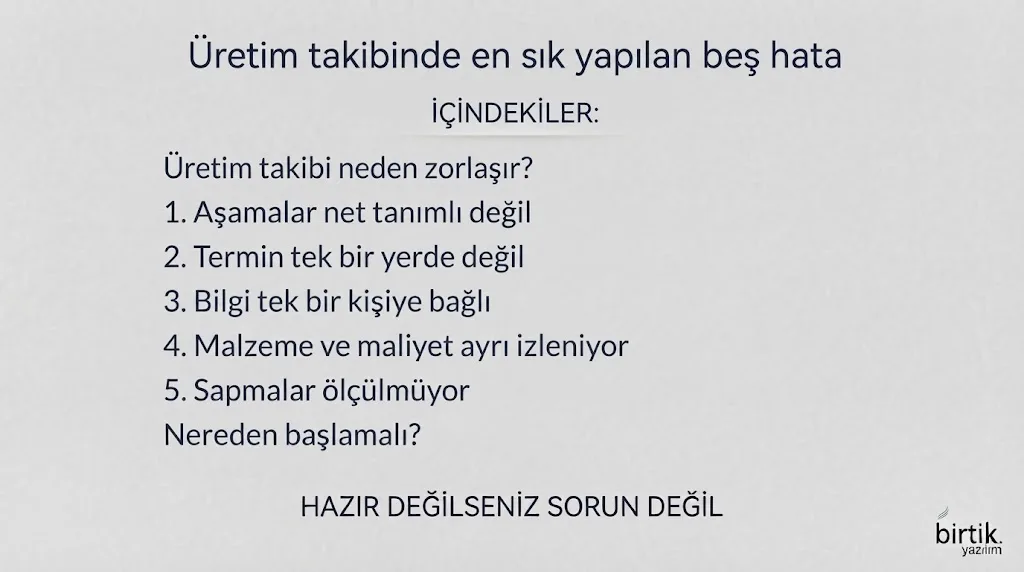
Why does production tracking get hard?
Information changes fast in production: an order comes in, a work order is opened, material is awaited, a machine breaks down. If the tracking method cannot keep up, information arrives late and everyone starts working from their own guess.
1. Stages are not clearly defined
What does "in progress" mean? Cutting, assembly, packaging? Reduce the stages to a few clear steps that everyone uses in the same sense. Every work order should be in exactly one of these steps at any time.
2. The deadline is not in one place
The delivery date is in one sheet and, verbally, in someone else's head. The deadline should be attached to the work order, and upcoming or late jobs should surface automatically.
3. Information depends on one person
"Ahmet is on leave, we do not know which job is where." If tracking relies on one person's memory, production slows when that person is away. Data should live in a shared system.
4. Material and cost are tracked separately
Production in one place, stock in another, cost in a third sheet. You only see what a job really cost at month end, by merging by hand. Material and labour attached to the same work order show the cost instantly.
5. Variances are not measured
If the difference between planned and actual time is not measured, the next quote is again based on a guess. Comparing planned and actual on every job improves pricing and capacity planning.
Where to start?
Clarify the stages and deadlines and bring them onto one shared screen. You can add the cost and stock link later. If you want a production tracking screen built for your business, we can map your processes together.